Calculating Tax on a Used Car in Quebec
Selling or buying a used car privately in Quebec doesn't follow the usual GST and QST rules. Only one tax applies, and it isn't always calculated on the price written on the bill of sale.

The Higher-Amount Rule
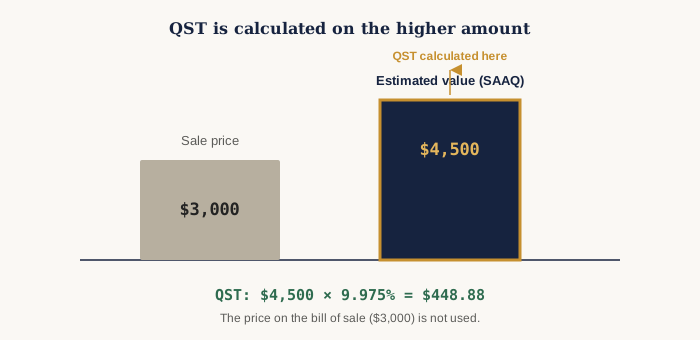
For a road vehicle sold between individuals, Revenu Québec calculates QST on the higher of two amounts: the sale price on the bill of sale, or the vehicle's estimated value. The rule exists to stop a seller and buyer from agreeing to declare an artificially low price to reduce the tax owed.
The estimated value is the vehicle's average wholesale price minus $500. Revenu Québec gives the example of a vehicle with an average wholesale price of $13,000: its estimated value is $12,500. QST is paid to the SAAQ when the registration is transferred: if the declared price is lower than the estimated value, that value becomes the tax base, not the price actually paid.
Worked Example
A used car sells for $3,000 between individuals, but its estimated value is $4,500 (an average wholesale price of $5,000, minus $500). QST isn't calculated on the $3,000 actually paid, but on the estimated $4,500:
Example: car sold for $3,000, estimated value of $4,500
$4,500.00 × 9.975% gives $448.875, rounded to $448.88 of QST. The buyer therefore pays $3,000 to the seller, then $448.88 of QST to the SAAQ at registration, a total of $3,448.88, even though the actual purchase price was only $3,000. If the vehicle had sold for $5,000 (above the $4,500 estimated value), QST would have been calculated on the $5,000 actually paid, since that would then be the higher of the two amounts.
Why GST Doesn't Apply
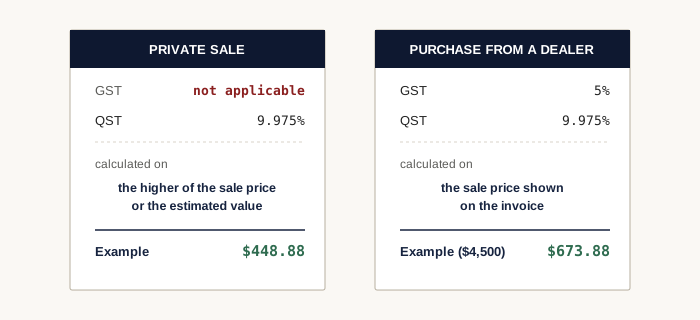
Unlike a purchase from a dealer, a private sale isn't subject to GST. GST applies to supplies made in the course of a commercial activity by a registrant; an individual selling their own car, as a one-off, isn't acting as a business and doesn't collect GST. Only Quebec's QST applies, following the higher-amount rule described above.
At a dealer, things are different: the dealer is registered for GST and QST, and both taxes apply normally to the listed sale price, with no estimated value involved.
Exceptions to the Rule
Revenu Québec provides two exceptions to the higher-amount rule:
- Sale between related individuals. When the vehicle is sold between related individuals (for example between spouses, or between a parent and child) for less than the estimated value, QST is calculated on the price agreed between the parties, whether or not any money changes hands. A transfer between an aunt or uncle and a niece or nephew is treated the same way.
- Damaged or abnormally worn vehicle. If the price is below the estimated value because the vehicle is damaged or abnormally worn, the buyer can pay QST on that reduced price, provided they give the SAAQ an appraisal report from a certified appraiser. If QST was already paid on the estimated value, the overpayment can be refunded with form VD-60.R.
What About Other Provinces?
Quebec isn't alone in regulating private vehicle sales this way. Ontario, for example, also applies its own tax on used vehicles bought from an individual, calculated on the vehicle's estimated market value when the declared price is lower (a comparable mechanism in principle, even though the rate and valuation method differ from Quebec's). The full detail of those rules is beyond the scope of this article, which stays focused on the Quebec system.
Calculating Tax on Another Amount
The Quebec sales tax calculator applies the general 9.975% QST rate, or 14.975% for GST and QST combined, useful for quickly checking a calculation once you know the exact amount (sale price or estimated value) the tax should be based on. To work back from a tax-included amount, see the reverse sales tax calculator.
Related Articles
-
Calculating GST or QST on Their Own
Isolate just one of Quebec's two taxes, without going through the 14.975% combined rate, useful for a tax return or an out-of-province purchase.
-
GST and QST Formula for Excel and Google Sheets
The exact formulas to copy into a spreadsheet, with the cent rounding that's missed most often, for all thirteen provinces and territories.
-
Calculating Tax on a Self-Employed Worker's Invoice
The $30,000 registration threshold, mandatory information on the invoice, and a full worked example.
-
Welcome Tax: Calculating Land Transfer Duties in Quebec
A real estate purchase isn't subject to GST or QST, but a different bracket-based calculation applies instead.
-
Calculating Quebec's Lodging Tax (3.5%)
Another Quebec special case: the 3.5% tax on the room rate, with GST and QST on top.
Sources
- Revenu Québec · Purchase of a used road vehicle from an individual
- SAAQ · Registering a car or motor home sold between individuals
- Revenu Québec · Basic rules for applying the GST/HST and QST
Article provided for informational purposes, current with the rates in effect in 2026. Valuation rules and exceptions for road vehicles fall under the SAAQ and Revenu Québec; if in doubt about a specific transfer, check with those agencies. CalculatriceTaxes.ca is an independent site, not affiliated with the Canada Revenue Agency, Revenu Québec or the SAAQ.