Welcome Tax: Calculating Land Transfer Duties in Quebec
The “welcome tax” (officially, the duty on transfers of immovables) isn't a sales tax. It's paid once, at purchase, and is calculated in graduated brackets on the tax base, more like income tax than like GST or QST.
Transfer Duty Calculator (Base Brackets)
Enter the tax base, usually the purchase price, unless the municipal assessment is higher (see below). The calculation uses the base brackets, in effect everywhere in Quebec.
Calculation receipt
Above $500,000, this result is a minimum. Several large municipalities, including Montreal and Quebec City, apply higher rates on the portion above $500,000. See those two cities' brackets below, and confirm the exact rate with your municipality before relying on it.
The Base Brackets: Three Graduated Tiers
The Act respecting duties on transfers of immovables sets a minimum bracket structure that applies in every Quebec municipality. Each bracket only applies to the portion that falls within it: it isn't a single rate applied to the whole amount.
| Portion of the tax base | Rate |
|---|---|
| $0 to $62,900 | 0.5% |
| $62,900.01 to $315,000 | 1.0% |
| Over $315,000 | 1.5% |
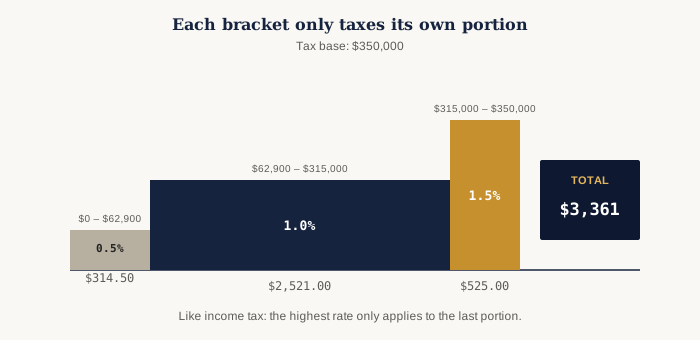
Example: $350,000 property (base brackets)
The Tax Base: Not Always the Listed Price
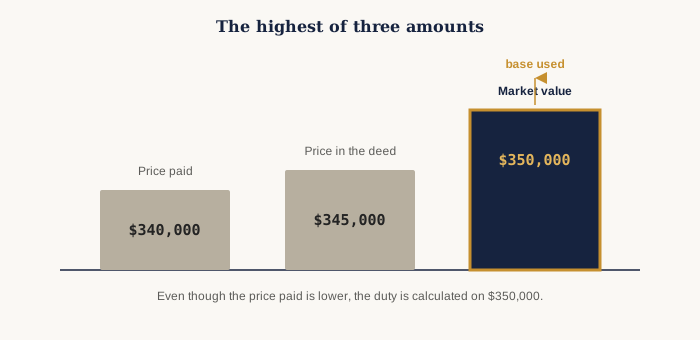
The duty isn't necessarily calculated on the sale price. The tax base is the highest of these three amounts:
- the price actually paid;
- the consideration stated in the deed of sale;
- the market value, meaning the municipal assessment multiplied by the comparative factor of the roll in effect.
A property sold below its adjusted municipal value is therefore still taxed on that higher value, not on the price actually paid. No duty is payable when the tax base is below $5,000.
Montreal and Quebec City: Higher Brackets Above $500,000
The base brackets are only a legal minimum. A municipality can set higher rates on the portion above $500,000, and several large cities do. Montreal even has special authorization to exceed the 3% cap imposed on other municipalities.
| Portion | Rate |
|---|---|
| $0 to $62,900 | 0.5% |
| $62,900 to $315,000 | 1.0% |
| $315,000 to $552,300 | 1.5% |
| $552,300 to $1,104,700 | 2.0% |
| $1,104,700 to $2,136,500 | 2.5% |
| $2,136,500 to $3,113,000 | 3.5% |
| Over $3,113,000 | 4.0% |
Example: a $700,000 property in Montreal generates $9,349 in transfer duties, versus $8,611 with the base brackets alone, a $738 difference.
| Portion | Rate |
|---|---|
| $0 to $62,900 | 0.5% |
| $62,900 to $315,000 | 1.0% |
| $315,000 to $500,000 | 1.5% |
| $500,000 to $750,000 | 2.5% |
| Over $750,000 | 3.0% |
These two examples show how large the gap can be: Montreal and Quebec City each have their own brackets, different from each other and from the base brackets. Nothing guarantees another municipality doesn't also have its own tiers above $500,000. For a purchase below that threshold, the base brackets give the exact amount anywhere in Quebec; above it, always check the brackets published by the municipality concerned.
Who Is Exempt
Two common situations escape the transfer duty:
- Between spouses: married, in a civil union, or in a de facto union for at least 12 months before the transfer;
- In the direct line: from a parent to a child, or from a grandparent to a grandchild, in either direction.
A transfer between siblings is not exempt: in tax law, that relationship is a collateral line, not a direct line. Even when the exemption applies, the municipality may charge a compensatory duty of up to $200.
Where the Name “Welcome Tax” Comes From
A widespread belief attributes the nickname to minister Jean Bienvenue (whose surname means “welcome”), who supposedly proposed the law. That's inaccurate: Mr. Bienvenue was part of the Liberal government defeated in November 1976, and neither sponsored the bill nor recommended the measure. The law was passed in December 1976 by René Lévesque's government, which created a new source of revenue for municipalities in exchange for reduced provincial transfers from Quebec sales tax. The expression “taxe de bienvenue” only appears in newspapers from 1982 onward, well after the law was passed.
Frequently Asked Questions
Is the welcome tax paid every year?
No. It's a duty paid once, at purchase, unlike municipal property tax, which comes back every year. The municipality usually sends the bill a few months after the transaction is entered in the land register.
Who pays the welcome tax?
The buyer. The seller has no obligation for this duty, which the municipality where the property is located charges to the new owner entered in the land register.
What amount is the welcome tax calculated on?
On the tax base, which is the highest of three amounts: the price actually paid, the consideration stated in the deed of sale, or the market value (municipal assessment multiplied by the roll's comparative factor). It isn't necessarily the listed sale price.
Are there exemptions?
Yes, notably between spouses (married, in a civil union, or in a de facto union for at least 12 months) and in the direct line, meaning between parent and child or between grandparent and grandchild. A transfer between siblings isn't exempt, because it's a collateral line. Even when exempt, a municipality may charge a compensatory duty of up to $200.
Do the Calculation
The transfer duty is separate from the sales taxes calculated elsewhere on this site. For GST and QST on a new-build property purchase (construction, not resale), see the sales tax guide. For any other sales tax calculation, the sales tax calculator remains the go-to tool.
Sources
- Gouvernement du Québec · Droits sur les mutations immobilières (in French)
- Ville de Montréal · How property transfer duties are calculated
- Ville de Québec · Droits sur mutation immobilière (in French)
- Ville de Montréal · Exemptions on property transfer duties
- Wikipédia · Taxe de bienvenue, origin of the name (in French)
Article provided for informational purposes, current with the 2026 brackets verified against the sources above. CalculatriceTaxes.ca is an independent site, not affiliated with any municipality or with the Government of Quebec. Your municipality's brackets may differ from those shown here: always confirm the exact amount with it or with your notary before a transaction.