Calculating Tax on a Self-Employed Worker's Invoice
A self-employed worker charges GST and QST exactly like any other business, provided they're registered. The hard part isn't the calculation, which is the same percentage applied to the price before tax, but knowing when registration becomes mandatory and what to show on the invoice.
When to Register for GST and QST
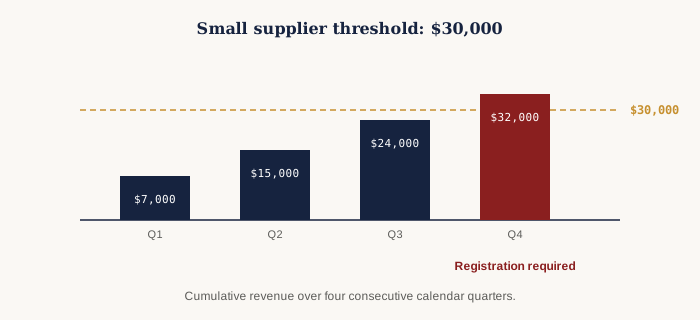
A self-employed worker must register for GST and QST as soon as revenue exceeds $30,000 over four consecutive calendar quarters: the small supplier threshold. Below that threshold, registration stays optional: without it, no tax is charged to clients, but no tax paid on business expenses can be recovered either.
Once registered (voluntarily or because the threshold was exceeded), GST and QST must be collected on every taxable sale from then on, with no exception for clients below a certain amount.
The Calculation Doesn't Change
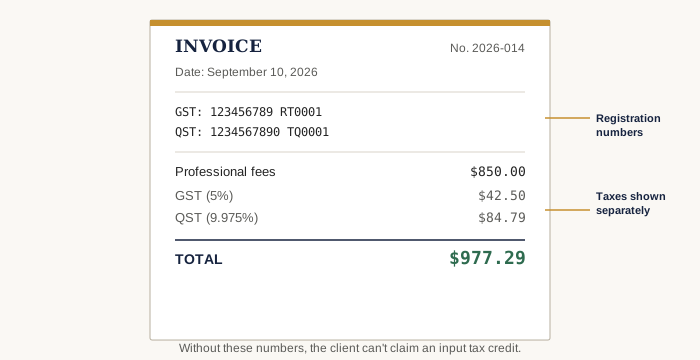
Once registered, calculating tax on an invoice follows the same rule as any purchase in Quebec: GST (5%) and QST (9.975%) apply separately to the before-tax amount of the service or goods billed.
Example: $850.00 service invoice, registered self-employed worker in Quebec

What a Compliant Invoice Must Show
Beyond the calculation, a compliant invoice carries information the calculator doesn't produce:
- the GST registration number (format
123456789 RT0001); - the QST registration number (format
1234567890 TQ0001); - the invoice date and a sequential invoice number;
- the amount of each tax shown separately, never merged into a single tax total;
- a description of the goods or service provided.
Without both registration numbers displayed, a client generally can't claim an input tax credit for that purchase, even though the tax was actually charged.
Collecting Isn't Keeping
GST and QST collected on an invoice aren't part of the self-employed worker's income: they're collected on behalf of the Canada Revenue Agency and Revenu Québec, then remitted on a schedule set at registration (monthly, quarterly or annually depending on revenue). A registered self-employed worker can also deduct, from what they remit, the GST and QST paid on their own business expenses: input tax credits.
Invoicing a Client Outside Quebec
The applicable rate generally depends on where the goods or service are consumed, not on where the self-employed worker is based. A service provided to an Ontario client may be subject to the 13% HST rather than Quebec's GST and QST, depending on the exact nature of the service. These place-of-supply rules have exceptions; if in doubt about an interprovincial sale, check with an accountant or official sources before invoicing.
Calculate an Invoice
The sales tax calculator gives the GST/QST breakdown for all thirteen provinces and territories, in both directions. Questions about using the tool for invoicing are covered in the FAQ.
Related Articles
-
Calculating GST or QST on Their Own
Isolate just one of Quebec's two taxes, without going through the 14.975% combined rate, useful for a tax return or an out-of-province purchase.
-
GST and QST Formula for Excel and Google Sheets
The exact formulas to copy into a spreadsheet, with the cent rounding that's missed most often, for all thirteen provinces and territories.
-
Calculating Tax on a Used Car in Quebec
For a private sale, only QST applies, calculated on the sale price or the vehicle's estimated value, whichever is higher.
-
Calculating Sales Tax in Ontario: the 13% HST
Which tax to charge a client in another province: the place-of-supply rule, with examples.
-
Calculating Quebec's Lodging Tax (3.5%)
For anyone billing lodging: the 3.5% tax becomes part of the GST and QST base.
Sources
Article provided for informational purposes, current with the rates in effect in 2026. It doesn't replace advice from an accountant or official sources on registration, remittances and tax credits. CalculatriceTaxes.ca is an independent site, not affiliated with the Canada Revenue Agency or Revenu Québec.